

Some people thrive in certain roles. Others struggle. Understanding why has been a challenge in workplace psychology for decades.
The Big 5 personality traits model gives us a framework to understand these differences. It’s also known as the five-factor model. It breaks down human personality into five measurable dimensions. These dimensions influence how people approach their work, interact with colleagues, and respond to workplace demands.
This article explains what the Big 5 model is, how it works, and how businesses use it for hiring and management decisions.
What is the Big 5?
The Big 5 is a way of understanding and measuring personality. It’s based on five broad personality traits that shape how people think, feel, and behave at work. This model of personality is also called the five-factor model or OCEAN model.
These five personality factors are Openness, Conscientiousness, Extraversion, Agreeableness, and Neuroticism (or sometimes Non-Negativity). They form the basic dimensions of personality. Every person falls somewhere on a scale for each of the personality dimensions. The scale runs from low to high.
The Big 5 personality test is different from personality types frameworks. It doesn’t put people into boxes.
Instead, it recognises that personality exists on a spectrum. Someone isn’t simply an “introvert” or “extrovert.” They might fall somewhere in the middle, or they might lean one way depending on the situation.

Why businesses use the Big Five
Understanding personality traits helps organisations make better decisions. This includes hiring, team development, and leadership planning.
The Big Five model of personality is widely used in business. It’s built on decades of personality research. It’s been tested across different cultures, industries, and languages.
This model of personality structure is different from many other frameworks. It measures traits on a spectrum instead of sorting people into rigid personality types. This gives more useful insights into how people actually work.
The framework shows how people naturally approach their work. It shows how they collaborate with others, respond to change, and handle workplace pressures.
These insights help in several areas:
- Hiring and selection – Finding candidates whose working style fits the role and team.
- Team building – Understanding the mix of personalities in a team. Seeing how different traits work together or clash.
- Leadership development – Spotting which traits support good leadership. Finding where leaders may need extra support.
- Performance management – Adjusting feedback and management styles to fit different working styles.
- Employee engagement – Creating work environments that suit different personality profiles.
Many organisations use personality assessment alongside other tools. They combine it with skills tests and performance data. This helps them make better decisions.
The Big 5 personality traits
Everyone falls somewhere on the scale for each of the big five traits. They might score high, low, or somewhere in between.
None of these scores is better or worse than another.
A high score on one of the big five personality dimensions might be perfect for a software developer. But that same score could be a problem for a sales role.
1. Openness to experience: How people approach new ideas and change
Openness to experience measures curiosity, creativity, and willingness to try new approaches.
High Openness
High openness shows up when someone is energised by change and new things. They’re comfortable with unclear situations. They enjoy brainstorming. They often come up with creative solutions to problems. These are the people who suggest trying a completely different approach when the standard method isn’t working.
You’ll see them volunteer for new projects. They question existing processes. They bring fresh ideas to team discussions.
Low Openness
Low openness looks like a preference for proven methods and clear structure. These people do well when there’s a tested process to follow. They’re less interested in reinventing things. They focus on doing things reliably.
You’ll notice they prefer detailed instructions. They may push back on organisational changes. They’re most comfortable when expectations are clearly defined.
Where Openness Matters Most
High openness is valuable in roles that need innovation, strategic thinking, or frequent changes. Think product development, creative positions, or startup environments. Low openness is an asset in roles that need precision, consistency, and following established procedures. Think compliance, quality control, or traditional industries.
2. Conscientiousness: How people approach responsibility and organisation
Conscientiousness is about self-discipline, organisation, and reliability.
High Conscientiousness
High conscientiousness means someone who plans ahead and meets deadlines without reminders. They follow through on what they promise. They’re methodical in their work. They rarely need to be chased for deliverables.
In your workplace, they arrive prepared to meetings. They keep organised systems. They can be trusted to handle important tasks on their own.
Low Conscientiousness
Low conscientiousness shows up as more spontaneous and flexible. But often less structured. These people may struggle with time management. They might put off less interesting tasks. They work better in environments that don’t require strict organisation.
You might notice they’re late with paperwork. They need more supervision on long projects. They prefer variety over routine.
Where Conscientiousness Matters Most
High conscientiousness is critical in roles that need attention to detail, project management, or independent work. Think accounting, project coordination, or any position where missed deadlines have serious results. Lower conscientiousness can work in creative roles or fast-paced environments where flexibility matters more than structure.
Extraversion: How people recharge and engage with others
Extraversion measures where someone gets their energy. From social interaction or from time alone.
High Extraversion
High extraversion means someone who’s energised by people. They think out loud. They enjoy group work. They often take the lead in social situations. Silence doesn’t feel comfortable. Conversation does.
At work, they’re likely vocal in meetings. They network quickly. They’re comfortable with public-facing work. They often move toward the centre of team activities.
Low Extraversion
Low extraversion (introversion) means someone who recharges through alone time. They prefer one-on-one conversations to group settings. They think before speaking. Constant social interaction drains them.
You’ll see them contribute thoughtfully but selectively in meetings. They prefer written communication for complex ideas. They need quiet time to do their best work.
Where Extraversion Matters Most
High extraversion is essential for sales, customer-facing roles, team leadership, and positions that need extensive networking. Low extraversion is an advantage in roles that need deep focus, independent work, or detailed analysis. Think research, technical writing, or programming.
Agreeableness: How people interact and build relationships
Agreeableness reflects how someone prioritises harmony and considers others’ needs.
High Agreeableness
High agreeableness shows up as cooperative, empathetic, and accommodating. These people naturally smooth over conflicts. They consider how their actions affect others. They prioritise team harmony.
In practice, they’re easy to work with. They’re quick to help colleagues. They’re skilled at building positive relationships across the organisation.
Low Agreeableness
Low agreeableness doesn’t mean someone is unpleasant. It means they’re more direct, competitive, and comfortable with conflict. They’ll challenge ideas openly. They prioritise results over feelings. They push back when they disagree.
You’ll notice they’re more willing to have difficult conversations. They’re less concerned about being liked. They focus on outcomes over relationships.
Where Agreeableness Matters Most
High agreeableness is valuable in roles that need collaboration, customer service, or conflict resolution. Think HR, healthcare, or client success. Lower agreeableness can be an asset in roles that need tough decisions, negotiation, or challenging the status quo. Think senior leadership, sales negotiation, or legal work.
Neuroticism: How people respond to stress and uncertainty
Neuroticism (or often Non-Negativity) measures emotional stability and how someone handles pressure.
Neuroticism: How people respond to stress and uncertainty
Neuroticism (or often Non-Negativity) measures emotional stability and how someone handles pressure.
High Neuroticism
High neuroticism means someone experiences stress, anxiety, and emotional ups and downs more intensely. They may worry about potential problems. They take criticism personally. They need more reassurance.
At work, you might see them second-guess decisions. They react strongly to setbacks. They need more emotional support during challenging periods.
Low Neuroticism
Low neuroticism (high emotional stability) shows up as calm under pressure. Resilient after setbacks. Generally even-tempered. They don’t dwell on problems. They bounce back quickly from criticism.
In practice, they stay composed during crises. They handle uncertainty without getting overwhelmed. They maintain consistent performance regardless of external stress.
Where Neuroticism Matters Most
Low neuroticism is crucial for high-stress roles. Think emergency services, crisis management, or executive leadership. Or any position with tight deadlines and high stakes. Higher neuroticism can be manageable in stable, supportive environments with predictable routines and clear expectations.
How the Big Five personality traits are measured
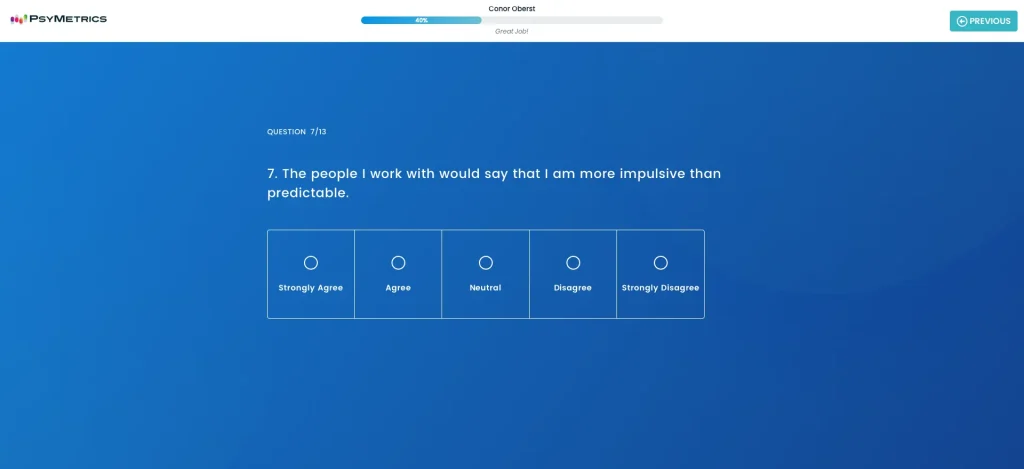
Big 5 traits are measured through psychometric tests or personality questionnaires. Candidates respond to statements about their typical behaviour, thoughts, and feelings.
They’ll see statements like “I am always prepared” or “I get stressed easily.” They rate how much they agree or disagree. Usually on a scale from “strongly disagree” to “strongly agree.”
A good personality assessment typically includes 50+ questions. It takes 10-20 minutes to complete. The questions measure each of the five personality factors from multiple angles. This improves accuracy. It also makes it harder for someone to game the system.
The assessment produces a personality profile. It shows where the person falls on the spectrum for each of the specific traits. It’s not a personality type. It’s a profile showing their tendencies across all five dimensions of personality.
You can explore InterACT-Global’s OCEAN test here.
Using the Big 5 in your organisation
The timing and application of personality assessment depends on your specific needs.

For Hiring
Many organisations use it after initial screening but before final interviews. This provides objective data to complement résumés and helps structure more insightful interview conversations. For high-volume recruitment, testing earlier in the process can help efficiently identify candidates whose personality profile aligns with role requirements.
For Team Development
Personality profiles help managers understand the dynamics within their teams. When you know one team member prefers detailed planning while another thrives on spontaneity, you can assign work more effectively and prevent personality clashes from derailing collaboration.
For Leadership Development
Understanding a leader’s personality profile reveals both strengths to leverage and potential blind spots. A highly agreeable leader might need support with difficult conversations, while a leader low in openness might benefit from structured approaches to innovation.
For Performance Management
Knowing someone’s personality helps tailor your approach. Some people respond well to frequent check-ins; others find it micromanaging. Some appreciate public recognition; others prefer private acknowledgement.
The key across all applications is using personality data to inform decisions rather than dictate them. A personality profile is one piece of information, not the complete picture.
Understanding the Big 5 personality test results
You’ve got the scores. Now what?
First, understand there’s no universally “good” or “bad” score. A highly conscientious, introverted candidate might be perfect for your data analyst role. But they could struggle in your sales position.
Look for alignment between the personality profile and what the role actually demands.
- Does the job require managing unclear situations? Look for openness.
- Need someone who can work independently with minimal supervision? Conscientiousness might matter.
- Customer-facing position with difficult clients? You might want emotional stability.
Use the results to shape your interview questions.
Say someone scores low on conscientiousness but the role needs detailed project management. Dig into that. Ask them how they stay organised. How they manage competing priorities. How they ensure nothing falls through the cracks.
The results also help with onboarding and management. Understanding a new hire’s personality helps you adjust your approach. Some people need detailed feedback. Others prefer autonomy. Some thrive with public recognition. Others find it uncomfortable.
Does personality change?
Personality traits are relatively stable, particularly in adults. The core patterns you see in an assessment are likely to remain consistent over time.
But traits can shift gradually over time. Research shows people tend to become more conscientious and agreeable as they age, and less neurotic. Life experiences, career development, and intentional effort can create modest changes.
What changes more readily is how people manage their traits. An introverted manager can learn strategies to handle the social demands of leadership. A person high in neuroticism can develop coping mechanisms for stress.
For hiring purposes, it’s most practical to select candidates whose natural tendencies align with role requirements, rather than expecting significant personality shifts after they join.
Common questions about the Big 5 traits
Is there an ideal OCEAN personality profile?
No universal “best” personality profile exists. The optimal personality traits depend entirely on the role and work environment. Traits that make someone excel in one position may create challenges in another.
Does personality assessment create stereotypes?
When used properly, the Big 5 model measures tendencies rather than fixed limits. A person can score in a particular range and still develop capabilities outside their natural preferences. The assessment shows where someone’s default patterns lie. Not what they’re capable of achieving.
Can candidates manipulate their responses?
Well-designed personality tests include ways to detect inconsistent or socially desirable response patterns. Also, candidates who significantly misrepresent themselves typically struggle once in the role. The job demands won’t align with their actual working style.
Implementing Big 5 personality assessments
The Big 5 personality model gives insight into how people approach work, collaborate with teams, and respond to workplace demands.
Understanding personality adds an evidence-based dimension to decisions across hiring, team management, and organisational development. Organisations typically combine personality assessment with other evaluation methods. They use skills testing, performance data, and structured feedback together. This builds a complete view.
Whether you’re building a team, developing leaders, or making hiring decisions, measuring personality through the Big 5 offers context. It helps explain why people work the way they do.

Chris has over 30 years of experience as a senior manager and entrepreneur in Human Capital and people management. He has worked extensively with psychometric assessments and pre-employment testing, helping organisations hire the right people and build strong teams.