
What are Psychometric Tests and How to Prepare for them?
The Complete Guide to Psychometric Testing and Assessments.
Published 11/07/2024
Updated 28/11/2025
Written by: Chris Schutte

Psychometric tests are now a standard part of hiring at most large organisations. But what exactly are they, and why do employers care so much about them?
This guide explains what psychometric tests measure, how they work, and what you need to know—whether you’re a candidate facing one soon or an organisation considering using them.
Quick Navigation
What are psychometric tests or assessments?
Psychometric tests are standardised, scientifically-designed assessments that measure a candidate’s cognitive abilities, skills, personality traits, and behavioral tendencies.
If you’re applying for jobs—especially in graduate schemes, corporate roles, or competitive industries—you’ll very likely encounter one or more of these tests as part of the recruitment process.
Rather than relying solely on interview impressions or resume review, employers use these assessments to identify candidates most likely to succeed and stay engaged in their positions.

Most psychometric tests are now administered online via secure platforms. Candidates receive an invitation link via email, complete the assessment from their chosen location, and results are generated instantly. This scalability means employers can efficiently evaluate hundreds or thousands of applicants in a standardised way.
Psychometric testing and pre-employment testing removes the guesswork from recruitment. Instead of making hiring decisions based on instinct or subjective impressions, organisations can now make evidence-based decisions grounded in research and psychological science.
Why Do Employers Use Psychometric Tests?
Traditional recruitment methods—reviewing CVs and conducting interviews—have significant limitations. Research has consistently shown that these methods are poor predictors of actual job performance. Psychometric tests solve this problem by providing objective, science-backed measurements.
For more detail, see our guide on the key benefits of using psychometric testing.
Improved Decision-Making
Psychometric tests give hiring teams a complete picture of each candidate from multiple angles: how they think, solve problems, handle pressure, and work with others. This reduces guesswork in hiring decisions and gives confidence that you’re making choices based on evidence.
Engagement and Retention
Mis-hires are expensive. When you match candidates whose abilities and personality traits align with the role, they’re more likely to succeed, stay engaged, and remain with the organisation, reducing turnover and the constant cycle of recruiting and training replacements.
Speed and Accuracy
Organisations can quickly filter large applicant pools down to genuinely qualified candidates using standardised criteria. At the same time, the accuracy of these assessments means you’re identifying people most likely to perform well—not just processing applications faster, but smarter.
Main Types of Psychometric Tests
The Two Primary Categories
The majority of psychometric assessments fall into two main categories: ability tests (also called cognitive or aptitude tests and skills tests) and personality questionnaires. However, there are also specialised assessments used for specific industries and roles.
Numerical Reasoning Tests

Numerical reasoning tests are among the most commonly used psychometric assessments, particularly in finance, consulting, engineering, and graduate schemes.
What Do Numerical Reasoning Tests Measure?
These tests measure your ability to interpret numerical data, analyse trends, and draw conclusions from figures presented in tables, charts, and graphs. They assess whether you can use basic mathematical operations to solve real-world business problems under time pressure.
What to Expect
- Time Limit: Usually 20-30 minutes for 10-20 questions
- Format: Multiple choice questions based on numerical data in tables, graphs, and charts
- Difficulty: Questions increase in difficulty as you progress
- Scoring: Most tests do not use negative marking, so guessing is better than leaving questions blank
Typical Question Types
Numerical reasoning questions ask you to:
- Calculate percentages and proportions
- Interpret data from tables and charts
- Identify trends or patterns
- Make comparisons between datasets
- Answer “what if” scenarios based on numerical information
Verbal Reasoning Tests
Verbal reasoning tests assess your ability to comprehend written information, evaluate arguments, and draw logical conclusions from text.
What Do Verbal Reasoning Tests Measure?
These tests evaluate whether you can read and understand passages quickly, identify key information, and make logical inferences based solely on what’s written. They measure reading comprehension and logical reasoning—not your general knowledge or vocabulary.
What to Expect
- Time Limit: Usually 20-30 minutes for 15-20 questions
- Format: A passage of text followed by statements you must evaluate as True, False, or Cannot Say
- Length: Passages typically range from 50-300 words
- Difficulty: Questions vary in difficulty; some require simple comprehension, others require complex logical reasoning
Abstract Reasoning Tests

Abstract reasoning tests measure your ability to recognise patterns, understand logical sequences, and solve problems using visual information rather than words or numbers.
What Do Abstract Reasoning Tests Measure?
These tests assess your ability to think logically and solve novel problems you’ve never encountered before. They measure pattern recognition, spatial reasoning, and your ability to work with abstract concepts. Abstract reasoning is considered a strong indicator of general intelligence and learning ability.
What to Expect
- Time Limit: Usually 15-25 minutes for 10-20 questions
- Format: Series of visual patterns or sequences; you select the next item that continues the pattern
- Difficulty: These tests often feel difficult because the patterns can be complex and non-obvious
- No Prior Knowledge Required: You don’t need any specialised knowledge; reasoning alone solves these problems
Personality and Behaviour Tests
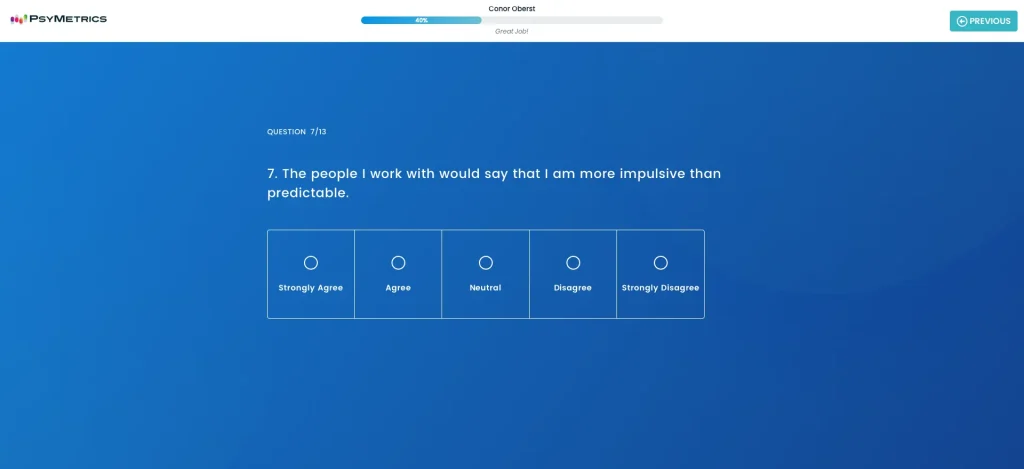
Unlike ability tests, which have right and wrong answers, personality and behavioural assessments measure your traits, values, motivators, emotional intelligence, and work style.
What Do Personality Tests Measure?
Personality tests assess how you’re likely to behave in the workplace, how you approach tasks, how you interact with colleagues, and what motivates you. They don’t judge whether your personality is “good” or “bad”—they simply measure traits and compare your profile against the role requirements.
Common dimensions measured include:
- Introversion vs. Extroversion
- Conscientiousness and attention to detail
- Emotional Intelligence and resilience
- Openness to change and new ideas
- Agreeableness and teamwork orientation
Key Characteristics of Personality Tests
- No Right or Wrong Answers: There are no “correct” responses; the test simply profiles your natural tendencies
- No Time Limit: Most personality assessments have no timer, allowing you to think carefully about each question
- Usual Time: These tests often take 15-30 minutes to complete
- Built-in Validity Checks: Quality personality assessments include questions designed to detect dishonest or exaggerated responses
Common Personality Assessment Tools
Organisations use various personality assessment frameworks:
- DISC – Measures Dominance, Influence, Steadiness, and Compliance
- Myers-Briggs Type Indicator (MBTI) – Categorises personality into 16 types
- Big Five – Measures five broad personality dimensions
- Hogan Assessments – Designed specifically for workplace behavior and performance
Using Personality Tests in Hiring
Employers use personality assessments to:
- Determine if you’ll fit the company culture
- Predict how you’ll work with your team
- Identify whether you have traits suited to the specific role
- Understand how to manage and motivate you most effectively
Situational Judgement Tests (SJT)

Situational judgment tests present realistic workplace scenarios and ask how you would respond. They assess your judgment, decision-making, and problem-solving in practical work situations.
What Do SJTs Measure?
These tests measure whether you can evaluate workplace situations effectively and make sound decisions. They assess common sense, professional judgment, and your ability to prioritize issues based on business and interpersonal factors.
How SJTs Work
You’re presented with a realistic workplace scenario—for example, a conflict between team members, a deadline pressure situation, or a customer service challenge. You’re then given 4-6 possible responses and asked to rank them from most to least effective, or select the best and worst responses.
Example Scenario
Situation: “You’re working on a critical project with a tight deadline. A colleague asks you to help them with a task unrelated to your project. Your manager is not in the office.”
Possible Responses (rank from most to least appropriate):
- Agree to help after you complete your current work
- Politely decline and explain your project deadline
- Help immediately because team collaboration is important
- Tell them to ask another colleague
- Ignore the request and continue working
SJTs evaluate how you balance competing priorities, show teamwork, maintain professional relationships, and handle pressure.
If you are trying to find assessments to use in your business, see how guide on how to choose the right psychometric test.
What to Expect During the Test

Before You Start
Most psychometric test platforms like InterACT-Global begin with detailed instructions. Read these carefully—they explain the question format, time limits, whether negative marking applies, and any special instructions.
Many platforms also offer practice questions or tutorial videos before the actual test begins. Use these to familiarise yourself with the interface, question style, and timing.
During the Test
Timed Assessments: Most ability tests have a timer visible on screen. Don’t fixate on it; focus on working at a steady pace. Remember, you’re not expected to answer every question perfectly—these tests are designed to be challenging.
Multiple Choice Format: Select your answer from the options provided. Most tests won’t let you change answers after you move to the next question, though some do allow review before submission.
Pacing Yourself: For timed tests, divide your time by the number of questions to know roughly how many seconds per question you have. If a question is taking too long, make your best guess and move forward. Leaving questions blank guarantees you won’t score points; guessing at least gives you a chance.
No Negative Marking (Usually): Most psychometric tests don’t penalise wrong answers. This means guessing is statistically better than skipping questions.
Technical Considerations
- Ensure you have a stable internet connection
- Use a quiet space without distractions
- Close unnecessary browser tabs and applications
- Have pen and paper available if needed for rough calculations
- Use a computer rather than a mobile device if possible (they’re easier to navigate)
- Ensure your screen brightness is adequate
If You Have a Disability
If you have a disability that could affect your test performance (hearing impairment, visual impairment, dyslexia, ADHD, etc.), inform the employer or test administrator beforehand. Many providers offer accommodations such as extra time, large text, screen readers, or alternative formats.
How hard are psychometric tests?
The difficulty of psychometric tests varies significantly depending on the test type, the role, and the organization.
Ability Tests Difficulty
Ability tests (numerical, verbal, and abstract reasoning) are typically adaptive, meaning they increase in difficulty as you progress. If you answer questions correctly, subsequent questions become harder. If you struggle, questions become more manageable. This creates a challenging experience for most test-takers.
Most ability tests are designed so that average test-takers complete only 40-60% of questions correctly. This is intentional—the tests aim to differentiate candidates across a wide ability range. So don’t be alarmed if you don’t finish or if you get many questions wrong.
Personality Tests: Not Difficult, Just Reflective
Personality assessments aren’t “difficult” in the traditional sense—there are no right or wrong answers. However, they require honest self-reflection. The difficulty lies in answering authentically rather than how you think you “should” answer.
Industry and Role Impact
Graduate scheme tests are typically more difficult than tests for entry-level roles. Consulting firms and investment banks use harder tests than other industries. This is intentional—these organisations want to filter for top academic performers and strong analytical thinkers.
Real-World Pass Rates
Large organisations using psychometric tests typically see pass rates (advancing to the next stage) of 10-20% for initial screening. This doesn’t mean 80-90% of candidates “fail”—it means the organisation is using the tests to identify the top performers for further evaluation.
Can you fail a psychometric test?
The short answer: technically, no. Most organisations don’t have a fixed “passing score.” Instead, they use your results to rank candidates and identify the top performers.
How Scores Are Actually Used
Organisations typically use psychometric results in one of two ways:
Ranking: Your scores are compared against other candidates. The top 10-20% advance to the next stage. You’re not compared to a fixed standard; you’re compared to other applicants.
Threshold Scoring: For some roles, organisations set a minimum acceptable score. If you fall below that threshold, you don’t advance. This is more common for specialised roles where a certain minimum competency is essential (e.g., specific technical knowledge).
Can You Actually Perform Poorly?
Yes, you can perform poorly in ways that eliminate you from consideration:
- Scoring in the bottom 20-30% of candidates
- Showing inconsistencies that trigger validity flags (answering personality tests dishonestly)
- Scoring well below the requirements for the specific role
- Running out of time on ability tests and leaving many questions blank
What Happens After the Test
If you don’t advance, you typically won’t receive detailed feedback explaining why. Large organisations process thousands of applicants and provide feedback only to candidates they wish to interview or hire. Some organisations do offer feedback upon request, particularly for personality assessments.
How to Prepare for Psychometric Tests

1. Practice Extensively
The single most important factor in psychometric test performance is practice. Familiarity with question types, formats, and time pressure dramatically improves your results.
- Take free practice tests available online (many organizations provide samples)
- Practice under realistic conditions: timed, in a quiet space, without distractions
- Repeat practice tests on areas where you struggled
- Review your answers and understand why you got questions wrong
Research shows candidates improve by 10-20% after taking just 3-5 practice tests.
2. Choose the Right Environment
Find a quiet space where you won’t be interrupted. Distractions significantly impact performance, especially on timed tests.
- Close office doors or work from home if possible
- Silence your phone
- Inform family members you need uninterrupted time
- Ensure adequate lighting and comfortable seating
- Check your internet connection beforehand
3. Read Instructions Carefully
Before starting the test, read all instructions thoroughly. These explain:
- How many questions you’ll face
- The time limit
- Whether negative marking applies
- How to submit your answer
- Any special instructions for that specific test
Taking 2-3 minutes to read instructions carefully can prevent critical mistakes.
4. Understand Test-Specific Strategies
Each test type benefits from different approaches:
Numerical Reasoning: Learn to quickly read charts and tables. Practice calculating percentages, ratios, and percentage changes. Develop rough mental calculation skills. For each question, identify what data you need before calculating.
Verbal Reasoning: Underline key information as you read the passage. Don’t rely on prior knowledge—use only the passage. Pay attention to absolute statements (“all,” “never”) and qualified statements (“some,” “usually”). Remember “Cannot Say” is often the correct answer.
Abstract Reasoning: Look for patterns in shape, size, rotation, shading, and position. Determine what transforms from one item to the next. If you can’t identify a pattern within 30-40 seconds, make an educated guess and move forward.
Personality Tests: Answer honestly based on how you actually behave, not how you think you should behave. The test will catch dishonest responses through validity checks.
5. Manage Your Time
For timed tests, time management is critical:
- Allocate roughly equal time to each question
- If a question is taking longer than your time allocation allows, make your best guess and move on
- Don’t spend 5 minutes on a single question when you have 20 questions to complete
- Remember: a wrong answer takes the same time as a blank answer, but has a chance of being correct
Science and Validation Behind Psychometric Tests
Psychometric tests are among the most scientifically rigorous assessment tools available. Reputable test providers invest heavily in validation research.
The Science Behind Psychometric Testing
Quality psychometric tests undergo extensive research to ensure:
Reliability: The test produces consistent results. If you took the test again tomorrow (without practice), you’d score similarly. Test developers measure reliability statistically and only release tests meeting strict benchmarks.
Validity: The test actually measures what it claims to measure. Numerical reasoning tests measure numerical reasoning, not reading comprehension. Personality tests measure personality, not intelligence. Validity is established through correlation studies showing tests predict actual job performance.
Standardisation: All candidates take the same test under the same conditions, making comparisons fair and meaningful.
Research Supporting Psychometric Tests
Decades of industrial-organisational psychology research confirms that psychometric tests are effective predictors of job performance. Meta-analyses (studies combining results from hundreds of individual studies) consistently show:
- Cognitive ability tests predict job performance across virtually all jobs
- Personality assessments predict specific job-related outcomes
- When multiple assessments are used together, predictive accuracy improves significantly
- Psychometric tests are more predictive than interviews, CV review, or reference checks alone
Built-in Safeguards
Quality psychometric assessments include validity checks to detect:
- Inconsistent or random responses
- Exaggerated or distorted personality responses
- Attempts to “fake good” or manipulate results
- Response patterns suggesting the candidate didn’t understand questions
If these flags appear, the test administrator is alerted and may request the candidate retake the assessment or flag results as potentially unreliable.
When Psychometric Tests Are Less Accurate
Test accuracy can be compromised by:
- Poor test administration or technical issues
- Candidate misunderstanding instructions
- Extreme test anxiety affecting performance
- Testing in a distracting environment
- Using lower-quality assessment tools (some tests aren’t scientifically rigorous)
This is why reputable organisations use established, validated assessments from recognised providers.
InterACT-Global's Psychometric Assessments Library
If you are exploring psychometric tests to use in your organisation, for hiring and selection, talent management, team building or leadership and succession planning, InterACT-Global provides 50+ assessments used by leasing organisations across a wide range of industries.

Author of this Article - Chris Schutte
Chris has over 30 years of experience as a senior manager and entrepreneur in Human Capital and people management. He has worked extensively with psychometric assessments and pre-employment testing, helping organisations hire the right people and build strong teams. Chris has hands-on experience in business development, HR, and improving workplace performance, with leadership roles across industries such as Manufacturing, Retail, and HR services. His practical approach to people and talent makes him a trusted expert in helping businesses get the best from their teams.
Common Questions About Psychometric Tests and Assessments
Psychometric tests are structured assessments designed to measure a person’s behaviour, personality, cognitive abilities, emotional intelligence, and work-related skills. They provide objective insights that help organisations make informed decisions about recruitment, development, and team performance.
InterACT-Global’s psychometric tests are scientifically designed and rigorously tested for validity, meaning they accurately measure the traits or abilities they claim to assess. Valid, reliable assessments ensure consistent, actionable results for hiring, development, and team-building decisions.
Psychometric assessments generally fall into five main types:
• Cognitive / Ability Tests – measure reasoning, problem-solving, and learning potential.
• Personality / Behavioural Assessments – assess work style, traits, and interpersonal behaviour.
• Emotional Intelligence (EI) Assessments – evaluate understanding and management of emotions.
• Situational Judgement Tests (SJTs) – scenario-based tests predicting workplace decisions and behaviour.
• Values & Culture Fit Assessments – identify drivers, motivators, and alignment with organisational culture.
Companies use psychometric assessments to improve hiring decisions by objectively evaluating candidates’ abilities, behaviour, and cultural fit. They reduce bias, save time and resources, and help select individuals most likely to succeed in the role and organisation.
Yes. Psychometric assessments provide insights for both recruitment and internal development. They can identify training needs, leadership potential, team compatibility, and engagement strategies for existing employees, while supporting fair and effective hiring for new candidates.
Absolutely. Psychometric tests are versatile and can be tailored for roles ranging from entry-level positions to senior leadership. Assessments help identify candidates or employees with the right skills, behaviours, and potential for success at any level.
The cost of a psychometric assessment depends on the type of test, number of participants, and reporting requirements. At InterACT Global, we focus on keeping assessments cost-effective for organisations of all sizes. We offer flexible pricing options, including special rates for high-volume testing, so you can scale your assessments across teams or multiple recruitment campaigns without unnecessary expense. Our approach ensures you gain high-quality, actionable insights while maximising value for your organisation.