

The costs of a bad hire are enormous. After weeks of training and onboarding, you realise the new employee doesn’t have the skills they claimed or can’t handle the job’s demands. The time and money already spent can’t be recovered, and now you’re back to square one.
This scenario is exactly why large organisations rely on pre-employment testing. It’s not about cutting corners—it’s about making smarter decisions before problems start.
What is pre-employment testing?
Pre-employment testing is any standardised assessment used to evaluate job candidates before making a hiring decision. These tests measure specific attributes, skills, or characteristics that relate to job performance.
Think of it as a way to see how candidates perform the job before you hire them. Rather than relying solely on what someone says in an interview or writes on a resume, testing provides objective data about their actual capabilities.
The tests themselves can measure everything from technical skills and cognitive ability to personality traits, emotional intelligence, integrity, and job-specific knowledge. What you choose to test depends entirely on what matters most for the role you’re filling.
Why do organisations use pre-employment testing in recruitment?
Testing helps organisations achieve two main goals:
- Speed up candidate selection and identify top talent faster
- Reduce the risk of hiring someone who won’t work out
The second point is particularly important. A bad hire can take weeks or months to become apparent, by which time significant resources have already been invested. Pre-employment testing helps catch potential mismatches early, before they become expensive problems.
Is it different from psychometric testing?
Psychometric testing is just a broad term that covers all these different assessment types.
When people talk about psychometric tests, they’re referring to the same kinds of assessments—personality tests, cognitive tests, skills assessments, and so on.
Pre-employment screening or testing simply means you’re using these assessments during the hiring and recruitment process. The terms are often used interchangeably.
Why not just use interviews and resumes?
This is the question many organisations ask before implementing testing. After all, interviews and resumes have been the standard for decades.
The problem is that resumes and interviews alone don’t give you the full picture. Resumes tell you what someone claims they can do. Interviews tell you how well someone presents themselves. Neither reliably predicts how someone will actually perform in the role.
Bias is common in both resume screening and interviews. Candidates get judged on superficial factors like where they went to university, gaps in employment, or how charismatic they are in person rather than whether they can actually do the job.
When should you test candidates?

The timing depends on your specific situation and what you’re trying to achieve.
For high-volume hiring situations (think graduate programmes or entry-level roles with hundreds of applicants) testing early in the process makes sense.
The cost of an assessment is often less than the hours spent manually reviewing resumes. You can quickly identify the strongest candidates and move them forward whilst screening out those who lack essential requirements.
For smaller businesses or more specialised roles, it often makes sense to have initial conversations first.
You might conduct a phone screen or preliminary interview, then invite promising candidates to complete an assessment. This approach works well when you need to evaluate culture fit or explain the role in detail before asking someone to invest time in testing.
Senior-level positions typically follow this pattern as well.
These candidates expect relationship building and detailed discussions about the role before any formal assessment. Testing might happen late in the process to validate specific capabilities or provide data points for final decision-making.
What about testing during probation?
Some organisations skip pre-employment testing entirely and rely on probation periods to evaluate new hires. By the time you’ve discovered someone isn’t suitable, you’ve already invested significant time and money in hiring, onboarding, and training them.
Probation periods serve a useful purpose as a final safeguard, but they shouldn’t be the first time you actually assess whether someone can do the job.
Types of pre-employment assessments
There are seven main categories of pre-employment assessments used in recruitment, each measuring different aspects of a candidate’s suitability for a role.
Cognitive Ability Tests and Aptitude
Cognitive and aptitude tests measure mental ability—how well someone learns, solves problems, and handles complex challenges. They evaluate reasoning, memory, attention to detail, and the ability to work with numbers, words, or abstract concepts.
These tests present timed questions with correct answers. Think numerical sequences, verbal reasoning puzzles, or pattern recognition. They work like IQ tests but focus on workplace-relevant abilities. These can include numerical reasoning, logical reasoning, verbal reasoning and abstract reasoning.

Why cognitive tests are common
Research consistently shows these are among the strongest predictors of job success across industries. They’re particularly valuable for roles with steep learning curves or complex problem-solving demands.
People with stronger cognitive abilities learn faster, adapt more easily, and handle complexity better. In demanding roles, these capabilities often matter more than personality traits or prior experience.
Personality Tests
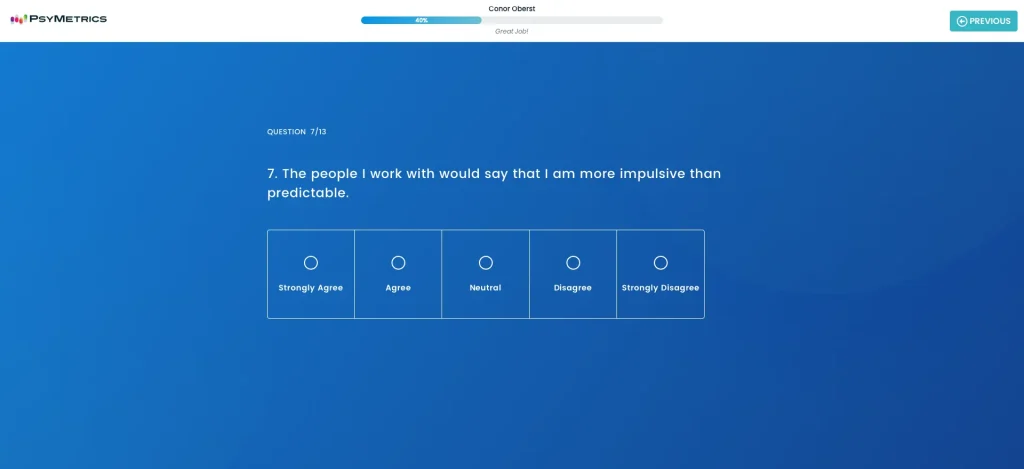
Personality tests measure behavioural traits, work style preferences, and how someone responds in different situations. Candidates answer self-report questions—choosing between statements, rating agreement levels, or ranking characteristics.
Common frameworks include the Big Five traits (openness, conscientiousness, extraversion, agreeableness, and non-negativity), DISC, or workplace-specific models measuring achievement orientation, teamwork, or adaptability.
There are no right or wrong answers
A highly extroverted candidate isn’t “better” than an introverted one—it depends on the role. Sales might benefit from high extraversion, whilst research roles might suit someone who thrives independently.
Organisations use these tests to understand team fit, stress tolerance, leadership approach, and customer interaction styles.
Results generally show as percentile scores against a norm group, not pass/fail grades.
Many candidates worry they’ve “failed” when they don’t get the job. Personality tests are not designed to assess competency, but can identify a mismatch between their natural working style and the role’s demands—which is better discovered early for both the individual and the company.
Skills Tests
Skills tests evaluate whether candidates can actually do the work. These practical assessments ask candidates to complete tasks similar to real job responsibilities.
A developer might write code to solve a problem. A writer might create an article. A customer service rep might respond to realistic scenarios.
Skills vs Knowledge
Skills tests measure what you can do. Knowledge tests measure what you know.
These tests assess both technical abilities (coding, data analysis, design, accounting) and soft skills (communication, problem-solving, collaboration). Formats vary—multiple choice for knowledge application, open-ended challenges, or immersive simulations recreating job scenarios.
Situational Judgement Tests

Situational judgement tests (SJTs) present realistic workplace scenarios and ask candidates how they would respond. These scenarios reflect actual role challenges—handling difficult customers, managing priorities, or resolving team conflicts.
Each scenario offers multiple response options. Candidates choose the best response, rank options by effectiveness, or rate how likely they’d take each action.
For example, a manager test might present two team members disagreeing on project direction. Options range from making a unilateral decision to facilitating discussion or escalating to leadership.
SJTs assess judgement, decision-making, and how candidates balance priorities or handle ambiguity. They work particularly well for assessing management skills, customer-facing roles, or jobs requiring ethical decisions.
Emotional Intelligence Tests
Emotional intelligence (EQ) tests measure self-awareness, self-regulation, empathy, social skills, and motivation. They evaluate how well someone understands and manages their own emotions and responds to others’ emotional states.
Tests might ask candidates to identify emotions in expressions, describe stress management, or explain responses to upset colleagues.
Some use scenarios: “A team member becomes defensive when you provide feedback. How do you respond?” Others use a self-report format like: “I usually recognise when I’m becoming frustrated before others notice.”
EQ matters for roles that require teamwork, leadership, customer interaction, or high-stress environments. For hiring, these assessments work best as one data point amongst several, identifying candidates who might excel at relationships or conflict management.
Integrity and Safety Tests
Integrity tests assess honesty, reliability, work ethic, and rule-following behaviour. They’re commonly used for positions involving financial responsibility, sensitive information, or safety-critical work.
Two Types of Integrity Tests
Overt tests directly ask about dishonest behaviour: “Is it acceptable to take office supplies home for personal use?”
Covert tests measure personality traits linked to integrity—conscientiousness, impulsivity, respect for authority—without directly mentioning dishonesty.
Safety tests evaluate attitudes towards workplace safety rules and risk-taking. They’re particularly relevant for machinery operation, hazardous environments, or roles where shortcuts endanger others.
These assessments work best combined with background checks, reference verification, and clear workplace policies.
Knowledge Tests
Knowledge tests assess theoretical understanding in a specific field. They measure what someone knows rather than what they can do with that knowledge.
These tests typically use multiple choice, true/false, or short answers. They’re straightforward to administer and evaluate quickly at scale.
They work best for roles where specific information is essential—common in regulated industries, technical fields, or positions requiring certification. For most roles, knowledge tests pair well with skills assessments that measure knowledge application.
How do you choose the right pre-employment tests?
The choice of pre-employment test depends on what you need to learn about candidates and what predicts success in the specific role.
Start by identifying your hiring challenges. If new hires consistently lack technical capabilities, skills assessments should be the priority. If turnover happens because people don’t fit the culture or struggle with team dynamics, personality or emotional intelligence tests might be more valuable. If integrity concerns exist, focused integrity testing makes sense.
See our more detailed guide for selecting the right psychometric or pre-employment tests for your organisation.

Identify what predicts success in your organisation
Look at what differentiates your top performers from those who struggle. Do they have stronger cognitive abilities? Better soft skills? Different personality traits? This analysis helps identify which assessments will provide the most useful signal.
Consider the role level and responsibilities. Entry-level positions might benefit from cognitive and skills tests to identify potential. Senior positions might require more emphasis on judgement, emotional intelligence, and leadership traits.
Most organisations find that combining multiple test types provides better results than relying on a single assessment. A common approach includes a skills test to verify capability plus either a cognitive test or personality assessment depending on role requirements.
The practical constraints matter too. High-volume hiring often requires quick, easily scored assessments early in the process. Specialised roles might justify more time-intensive evaluations later in the funnel.
How should you use assessment results?
Pre employment assessment results provide data to inform decisions, not make them automatically. The most effective approach combines test scores with other information like interviews, work history, and references.
Guide interview conversations
Assessment results can shape interview questions to explore areas of interest or concern. If a cognitive test shows strong analytical ability but a personality test suggests low attention to detail, you might probe how the candidate ensures accuracy in their work.
If a skills test reveals gaps in specific areas, job interviews can address whether those gaps are deal-breakers or can be addressed through training. This targeted approach saves time and provides more relevant information than generic interview questions.
Some assessment providers offer suggested interview questions based on results, giving you a starting point for deeper conversations.
Set realistic expectations
Test results help both employers and candidates understand whether the role is a good match. If a personality assessment shows someone thrives on variety and change, and the role involves highly repetitive tasks, that mismatch is worth discussing openly.
This transparency can prevent bad fits before they happen, saving both parties time and frustration.
Plan development and training
Assessment results identify areas where new hires might need support. A knowledge test might reveal gaps that training can fill. An emotional intelligence assessment can highlight opportunities for coaching in stakeholder management.
Having this information at the start allows for proactive development planning rather than waiting for problems to emerge.
Improve onboarding
Understanding a new hire’s work style, preferences, and strengths from day one allows managers to tailor their approach. Someone who scores high on independence might need less supervision. Someone who shows strong collaboration might benefit from immediate team integration.
This individualised approach can accelerate productivity and improve early retention.
Evaluate assessment effectiveness
Track how assessment scores correlate with job performance over time. If high scorers consistently perform well, the test is working. If the correlation is weak, the assessment might need adjustment or replacement.
This ongoing validation ensures your testing programme delivers actual value rather than just creating extra steps in hiring.
What else should you consider?

Legal and ethical compliance
Pre-employment testing must comply with employment laws, which vary by location. Tests should be job-related, validated for their intended use, and applied consistently across candidates.
Some types of testing face stricter regulations, particularly those that might create disparate impact on protected groups.
Candidate experience
Long, complicated, or poorly designed assessments can frustrate candidates and damage your employer brand. Tests should be reasonable in length, clearly explained, and user-friendly.
Providing feedback to candidates, even those not selected, demonstrates respect and professionalism.
Validity and reliability
Not all pre-employment tests are created equal. Valid tests actually measure what they claim to measure and predict job performance. Reliable tests produce consistent results.
Before implementing any assessment, verify it has been properly validated and shows reliability across different candidate populations.
Avoiding over-reliance
Tests provide valuable data but shouldn’t be the only factor in hiring decisions.
Human judgement, interviews, work samples, and references all contribute to a complete picture. The best hiring processes use assessments as one input amongst several.
Implementing pre-employment testing
Organisations implement effective pre-employment testing in different ways based on their needs and resources. Some use assessments immediately after application to screen large volumes of candidates efficiently. Others wait until after initial phone screens to test only serious contenders.
The timing and combination of tests should match your hiring process, volume, and role requirements. There’s no universal best practice—what works for a tech company hiring hundreds of customer service representatives differs from what works for a consulting firm hiring a handful of senior advisers.
The key is being intentional about why you’re testing, what you’re measuring, and how results will inform decisions. Clear purpose and thoughtful implementation make the difference between testing that improves hiring and testing that just adds extra steps.

Chris has over 30 years of experience as a senior manager and entrepreneur in Human Capital and people management. He has worked extensively with psychometric assessments and pre-employment testing, helping organisations hire the right people and build strong teams.